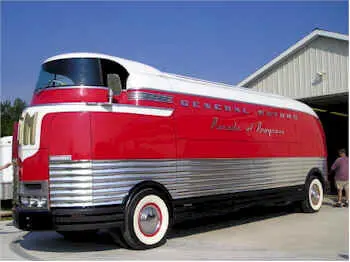
Donated to the museum in the early 90’s by Joe Bortz of Bortz Auto Collection, Futurliner #10 was in disrepair. As anyone who has restored a vehicle can attest, it was much worse than it looked – and it looked bad. A group of volunteers in the West Michigan area began restoring the vehicle in late 1998.
Led by Don Mayton, we owe a great deal of thanks to him and all the volunteers and contributors that helped with this project!
With volunteer labor and countless donations of materials and money, Futurliner #10 was completed 7 years later. For a more in depth recounting of the process, things found, and learned, you can visit Futurliner.org.
How the NATMUS Got the Futurliner
After its time in the Parade of Progress, Futurliner #10 spent time advertising. First for Goebel Beer company, then Pulte Construction in Detroit. Before it came to us, it was with a Cadillac dealer.
Joe Bortz saved 5 Futurliners from a life as a spoke restaurant. The middle one in the image below is #10, which he donated to us in the early 90’s.
The below photos show what our Futurliner looked like in 1998 when Don Mayton tracked it down. He was determined to find one to restore after seeing Bob Valdez’s #9 rebuilt as an RV earlier in the year. NATMUS had a Partner Program where he could take it home to restore and we would help raise the estimated $200,000 to complete it. So that’s what we did.
The museum then owned the Futurliner and Don and his crew of volunteers were happy to be part of an effort to bring the Futurliner back from the past.
Moving the Rusty Futurliner
In November 1998, the Futurliner was loaded on a trailer and headed north from Auburn, IN to Beaverdam, MI, just west of Grand Rapids. The wheels are resting on the outside edge of the trailer bed, a tight fight. Due to a lack of maneuvering room at Dons barn, the Futurliner had to be brought down the drive backwards. The tractor had a little trouble, but eventually got it down to the barn and tucked inside. Not shown are the half dozen attempts to get the behemoth in straight! This unheated barn was used during the first 18 months of the project, then a new addition was added in the spring of 2000. Which added not only heat, but much needed elbow room.
Disassembling the Futurliner
As restoration work began, the Futurliner had to be disassembled piece by piece. To disassemble the large parts of the Futurliner, it had to be pulled outside, and, of course, pushed back in at the end of the day.
A volunteer brought is hi-low tractor to help with the removal of the side bay doors and the light bar. The hi-low came in handy as a work platform for the roof area. The roof was rusted so badly that walking on it wasn’t possible.
Not only is the roof badly rusted but the structural design was not sufficient to support the weight or stress of opening the large display doors. Some of the Paraders recall needing up to 10 men to close the doors because the roof sagged and threw things out of alignment.
Redesigning the Roof
Due to rust, the old roof was so deteriorated that a new one needed to be constructed. In addition, conversations with Paraders on the Parade of Progress in the 1950’s revealed that the roof was weak and when all the doors were raised and the lighting fin was raised, the roof sagged. The sag was so great that often the doors could only be latched with the help of many Paraders pushing on the sides. The people that restored the Canadian Futurliner (FIDO) have already experienced problems with their roof sagging and latching the large 16′ doors. GM Designer Paul Jankowiak redesigned the roof structure for the Futurliner and allowed us to correct this design flaw.
After the engineer created the drawings, the roof was rebuilt off-site and then welded into place. As you can see from the pictures below, the roof was in poor condition.
New Tires for #10
The tires that were on #10 had seen much better days, but surprisingly they still held air! There were a couple that were original, and still had the embossed logos around the white walls.
Thanks to Ron Pratt and Coker Tire, we were able to have new mold created in 2006 to get a new set of tires! Complete with all the embossed lettering.
Restoring the Futurliner
The below photos show the state of the restoration and the end of 2002. Note the 4×4 holding the roof up. A good deal of bodywork had been done, and the engine bay door had been painted, just to show some color at fundraising shows.
At this point, you can see the old roof had been cut out. With a new drawing of the roof from GM designer mentioned before, we were able to ask a fabricator to build us a new one. The new roof was much sturdier than the original design and does not sag when the large 16′ doors are opened.
Rebuilding the Futurliner
After the framework was completed and the panels fitted, it was time to install the lighting fin. The dark bar in the center of the first image below is the large acme worm screw that the front carriage rides on.
Installing the fin is time consuming work – it needs to be precisely centered in the roof opening to fit correctly. Once the for and aft carriages were in place, the crew ran the fin down half way, and back up. Then down 3/4’s, and back up. No issues. But when they ran it down to within just a couple inches of closing, the motor could not muster the power to lift it back up. Knowing this was going to be an issue based on conversations with GM engineers, they had plans for lift assist cylinders. They determined 4 inches of assist was needed and then the main motor could continue on its own.
Futurliner at the Body Shop
The Futurliner went off to the body shop for finish work in late December of 2002 looking like the picture above. And came back in January of 2003 with the bottom finished and painted black. The bottom half is nearly all covered with trim so the men will begin installing that.
The Completed Futurliner #10
And that, friends, is how the Futurliner #10 came to be what it is today. We are grateful to have #10 in our car for people of all ages to love and admire.
Come see this Futurliner in our show room. Plan your trip today!